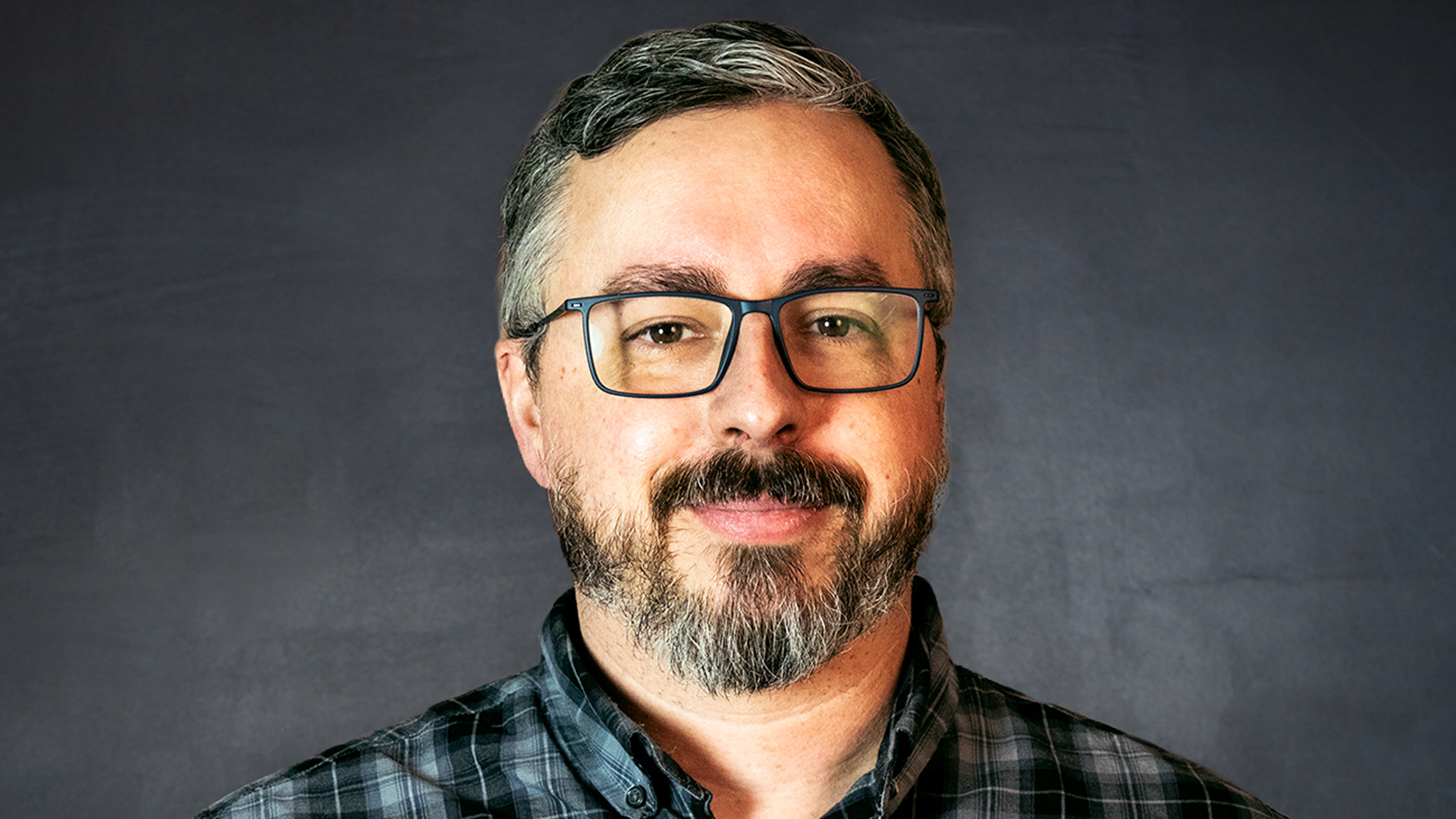
Mike Nack is the guy you want to QC your content – just don’t invite him to your next viewing party
“I’ve ruined every viewing party I’ve ever been to,” Mike admits. “Unless of course, we’re viewing of a piece of content we QC’d at Giant.” Like the company he works for, Mike’s got an eye for detail. “A piece of tape on the floor of a sound stage, hair combed the wrong way, a car that changes color in a badly edited scene – I see it all.”
As SVP of Studio Operations for Cineverse / Giant Worldwide (previously Chief Operating Officer, Giant Worldwide), Mike feels incredibly lucky to be where he is. Of course, his luck has been almost entirely self-made.
Q: How did you get started in content distribution, and why have you stuck with it for over 30 years?
Funny story: luck and timing played a big role in the beginning of my career. When I was 16, I needed gas and insurance money for my first car, so a family friend invited me to work at his corporate VHS duplication facility. I started by literally labeling tapes and putting them in sleeves. From there, I learned everything from QC and duplication to editing and audio CD mastering.
I transitioned into the digital age when my boss sent me to a DVD authoring seminar in San Jose just as the technology was emerging. That led to a career at Sony Music Studios making concert DVDs and Blu-rays, followed by leadership roles at Deluxe and eventually Giant. I’ve stuck with it because I love the attention to detail, the customer focus, the people I get to work with, and ultimately, the impact we’re able to have on audiences. We aren't solving world hunger, but we bring joy and comfort to people by helping them escape into a fantasy world or relive memories through their favorite old shows.
Q: What’s been the key to Giant’s success?
It comes down to being the "right size" and staying strictly client-focused. We’ve never been a massive corporate machine, but we haven’t been a "mom and pop" shop either. This allowed us to be a solid and reliable partner that was also fast and efficient when streaming platforms like Apple and Netflix first started. We were the “mama bear” solution from the outset, so we were able to establish ourselves as a preferred partner because we could help them work out the kinks of content ingest.
We also treat every film with a personal touch. Whether it’s an indie darling from A24 or Neon, or a blockbuster from one of the major studios, we monitor every title from beginning to end and take the time to work through everything our clients need. We have always focused foremost on the quality of what we were doing, not so much the quantity.
Q: How do you view the Matchpoint acquisition, and what does it mean for Giant customers?
I see the marriage of Matchpoint and Giant as the perfect solution to a scaling problem. Giant reached a peak where we couldn't scale our manual, "hands-on" service without massively increasing costs in people and space. Matchpoint built an extraordinarily powerful automation system that provides the speed and accuracy we needed at scale.
For our customers, this means they get the best of both worlds. Many studios have archaic internal systems and don't have the resources or desire to manage a SaaS platform themselves. Now, we can manage their catalogs using these automated tools. Tasks that used to take Giant months of manual work—like reformatting a thousand titles for a new deal with Amazon or Pluto—can now be done in a matter of hours with a few clicks.
Q: What will the integration of these two companies mean for the industry?
It signals a necessary shift toward full automation. I believe that within 10 years, the industry will be primarily automated. As standards constantly change—moving from SDR to HDR, or adding new formats like Dolby Atmos—you need an engineering-heavy platform that can keep up without needing a warehouse full of people writing manual code.
The integration allows us to take a "Production Ready Digital Master," QC it with human eyes to meet the high standards of partners like Apple, and then let the machine handle the hundreds of thousands of hours of work required to localize and distribute it globally. We’re taking the manual "grind" out of the supply chain, so high-quality content can reach audiences faster than ever – which is what it’s all about.